
Editor Elena Patera
Welcome to the April issue of Anastomosis. In this issue, we bring you the latest news from our members and from the Journal of Anatomy and Aging Cell.
If you have any news, events or announcements that you would like to see published in the newsletter, please send us an email by the 20th of each month. Items should reach the editor a minimum of 30 days before the date that the event is scheduled to take place. Please remember that you can visit our News Page at any time for the very latest news.
Education Committee Tip of the Month
'A Framework for Balancing Traditional and Digital Approaches in Anatomy Education'
Written by Sharmila Rajendran (Departmental Lecturer in Anatomy) and Professor Helen Christian (Associate Director of Preclinical Studies), Department of Physiology, Anatomy and Genetics, University of Oxford.
Anatomy education continues to evolve through technological innovation, curriculum reform, and improved laboratory infrastructure. Despite these developments, established methods—including cadaveric dissection, prosection, plastinated specimens, living and surface anatomy, and ultrasound—remain central to anatomical learning. These approaches cultivate spatial awareness, tactile proficiency, appreciation of anatomical variation, and professional and ethical conduct. At the same time, digital innovations such as 3D software, virtual and augmented reality, digital cadavers, interactive platforms, and AI-enabled tools have expanded access to visualisation, revision, and adaptive learning.
The rapid expansion of these technologies represents a transformative phase in medical education. While their integration is increasingly inevitable, their value depends on careful evaluation, alignment with curricular objectives, and pedagogical oversight. The key challenge lies in achieving balance—ensuring that digital tools enhance and extend, rather than replace, established donor-centred practices. A balanced anatomy curriculum must be guided by clear educational intent and defined learning outcomes, which vary across undergraduate, clinical, and advanced training programs.
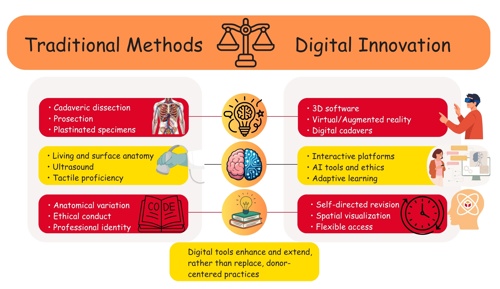
Hands-on competencies—such as developing tactile skills, recognising anatomical variability, and cultivating ethical awareness and professional identity—are best achieved through specimen-based, donor-centred learning. When cadaveric teaching is limited or unavailable, plastinated specimens, anatomical models, and museum collections offer valuable alternatives by allowing repeated study and exposure to anatomical variation, especially in resource-limited settings.
Digital platforms (such as annotated images, instructional videos and 3D applications) further support conceptual outcomes, including spatial orientation, integration of imaging, enabling repeated, self-directed engagement, revision and consolidation.
Imaging-based anatomy, including radiographs, CT, and MRI, reinforces cross-sectional understanding and strengthens connections between anatomy, radiology, surgery, and clinical reasoning. Living and surface anatomy, as well as point-of-care ultrasound, further bridge static anatomical knowledge with dynamic, critical-thinking skills.
Adaptive platforms and AI-assisted tools such as AI-assisted image analysis and guided interpretation may also facilitate personalised feedback and help identify knowledge gaps, provided their use remains aligned with academic standards and educational goals.
Achieving balance also depends on instructional design. Synchronous teaching is well-suited for guided dissection, prosection demonstrations, supervised ultrasound, peer-assisted learning, game-based learning and instructor-led digital-supported sessions. Asynchronous digital resources, such as narrated 3D models, interactive atlases, adaptive quizzes, and AI-enabled tutoring tools, support preparation, revision, and flexible access. Ensuring accessibility and learner support remains essential.
While some traditional activities may be supplemented or partially replaced by digital approaches, maintaining core donor-based and hands-on teaching is essential for educational continuity, ethical development, and professional identity formation. When thoughtfully integrated, traditional and digital methods together provide a cohesive, resilient, and sustainable framework for contemporary anatomy education.
References
Arráez-Aybar, L. A. (2025). Evolving Anatomy Education: Bridging Dissection, Traditional Methods, and Technological Innovation for Clinical Excellence. Anatomia, 4(2), 9. https://doi.org/10.3390/anatomia4020009
Bridging the gap: How cadaveric dissection and cutting-edge technology together shape tomorrow’s medical education. (2025). Medical Education, 29(3). https://doi.org/10.52083/RUTR3243
Would you like to tell the AS membership about your 'Tip of the Month', 'Anatomy Education Paper of the Month' or 'Anatomy Resource of the Month'?
We are looking for contributors who would be willing to write a short review on a 'Tip of the Month', 'Anatomy Education Paper of the Month' or 'Anatomy Resource of the Month. If you would like to contribute to an upcoming issue of Anastomosis, and join our bank of contributors please complete this form and we will be in touch!
Congratulations to the Latest Recipients of Anatomical Society Funding
If you would like to know more about how the Anatomical Society Funds our members, please see our full prize and funding matrix here. This month we would like to congratulate and latest recipients of the society's funding awards and provide you with the reports of the successful endeavours of recent awardees.
The Symington Bequest Travel Fund
The Trustees of the Symington Bequest Fund make grants to Society Members towards costs associated with the conduction and dissemination of anatomical research.
Congratulations to our most recent awardees! Below is the list of the names of the individuals who were awarded this travel fund, and the reports of previous awardees.
Academic Year 2025/2026
Round 1
Dr Alaa Alshwayyat participated in the 5th International Scientific Congress on Spinal Muscular Atrophy (SMA), Budapest, Hungary, 11th to 14th March 2026. REPORT
Dr Miranda Steacy participated in the Gordon Research Conference and Seminar: Morphogenesis and Tissue Regeneration, Ventura, California, USA, 21st to 27th March 2026. REPORT Photo
Round 2
Dr Marta Perera Perez participated in the Craniofacial Morphogenesis and Tissue Regeneration Gordon Research Conference, Ventura, California, USA, 22nd to 27th March 2026 REPORT Photo
Ms Eleni Melina Bell participated in the EMBO (European Molecular Biology Organization) Limb Development and Regeneration: Quantitative, Ecological and Diversification Studies Conference, Tokyo, Japan, 23rd to 27th of March 2026. REPORT
Anatomical Society Departmental Seminars Grants
The Anatomical Society awards grants to provide financial support to visiting speakers for seminars. Below is a report from a recent awardee.
Round 1
Award Holder: Dr Mutahira Lone
Hosted by: University College Cork, Ireland
Date: 19th February 2026
Key Speaker: Professor Iain Keenan, Newcastle University
Event Topic: Hybrid Seminar Exploring 3D Anatomy: Supporting Spatial Conceptualisation through Digital Visualisation and Art -based learning
New Fellows of the Anatomical Society
Following the March 2026 Council, the Anatomical Society is happy to announce that the following individuals have received the Anatomical Society Fellowship! Many congratulations to our most recent AS fellows!
Round 2 (elected by 03.03.26 Council)
Awardees:
Dr Declan McLaughlin
Professor Mark Midwinter
Professor Helen Nicholson
Dr Vivien Shaw
Deadlines for next round for Receipt of Applications
Award application deadline date for round 4 of the 2025/2026 award year:
Symington Bequest
Barclay Smith Travelling Fund
Fellowship of the Anatomical Society
Public Engagement and Outreach
Departmental Seminar Awards
Deadline: 16.06.2026
Award application deadline date for round 4 of the 2025/2026 award year:
Support for Student Societies
Deadline: 02.06.2026
N.B: For academic year 2025/2026 onwards, there will only be 5 prize rounds and council meetings.
Anatomy Research Developmental Awards 2025/2026
Please find below the approved reports for the two Anatomical Society Anatomy Research Developmental Awards for the academic year 2025/2026.
Awardee: Dr Shane Browne
Institution: Royal College of Surgeons in Ireland (RCSI)
Project Title: Next generation 3D model of ageing vasculature using cell-centred hydrogels
Awardee: Dr Benedicta Quaye
Institution: University of Lancaster
Project Title: High-plex In Situ Hybridization Profiling of the Ligamentum Arteriosum, Aorta, and Pulmonary Trunk in Murine Models
Undergraduate Summer Vacation Research Scholarships Report
Please find below an approved Project Report from a previous awardee of the Anatomical Society Undergraduate Summer Vacation Research Scholarship.
AWARDS MADE FOR 2025
Applicant: Dr Darren William Roddy
Institution: Royal College of Surgeons in Ireland (RCSI)
Student: Mr Ryan Lukin
Project Title: Detangling Disappointment: Mapping the Fasciculus Retroflexus from Diffusion MRI in Depression
Anatomical Society PhD Early Career Investigator Studentships
Please find below the approved project resume for one of the society's Early Career Investigator Studentships.
EARLY CAREER INVESTIGATOR STUDENTSHIP
Lead Supervisor: Dr Rebecca Rolfe
University: Trinity College Dublin
Co-Supervisor: Professor Paula Murphy
University: Trinity College Dublin
Project Title: Exploring sex-based differences in ligament development and maturation: Do they contribute to tissue vulnerability?
5th International Scientific Congress on Spinal Muscular Atrophy (SMA) - Europe 2026
The 5th International Scientific Congress on Spinal Muscular Atrophy (SMA) took place between 11th to 14th of March 2026 in Budapest, Hungary. Two former Anatomical Society funded PhD scholars, Dr Hazel Allardyce and Dr Cian O'Connor presented at the meeting.
Many congratulations to former AS PhD scholar Dr Cian O'Connor who has been awarded the community award which is an award made to recognise a presented research project that, from the SMA community’s perspective, demonstrates meaningful impact for people living with SMA in the short or long term.
The Community Award (with a €400 grant) was awarded to Dr Cian O'Connor (Harvard University, USA & Royal College of Surgeons in Ireland), for his presentation titled "Biomimetic Viscoelastic Hydrogels Promote Motor Neuron Outgrowth and Modulate Astrocyte Behaviour for Spinal Muscular Atrophy Regeneration Applications". Cian's work addresses the top research priority identified by the SMA community: the regeneration of motor neurons. Cian's team developed a hydrogel implant to improve the growth and health of motor neurons and the ability of astrocytes to provide neurotrophic support. The Community Award Committee acknowledged the development of an innovative approach to address an unmet need.
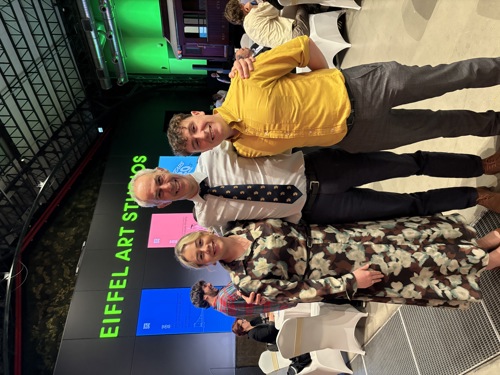
Below is a picture of former AS President Professor Simon Parson (middle) who met with Dr Hazel Allardyce (left) and Dr Cian O'Connor (right), former AS PhD scholars at the 5th International Scientific Congress on SMA in Budapest, Hungary.
Book Review Opportunity
'The Anatomy of Trauma: Anthropological and Clinical Perspectives' by Dr. Robert W. Mann
Members of the Anatomical Society are invited to volunteer to review the forthcoming publication 'The Anatomy of Trauma: Anthropological and Clinical Perspectives' by Dr Robert W. Mann. Members who are interested in undertaking this review are kindly asked to express their interest by emailing Ed Fenton (Managing Editor of the Journal of Anatomy) at janat@dpag.ox.ac.uk
Anatomical Society Best Image Prize May 2026
The next deadline for the Society's Best Image Prize is 31 May 2026.
There are two categories that images can be entered under: scientific image category and artwork image category.
Scientific images include histology, microscopy and radiological images and are typically produced from anatomical research projects.
Artwork images include drawings, paintings and photographs and are typically produced for educational purposes.
Applicants will be asked to choose which category they are entering their image for on the application form.
The maximum size limit for submitted images is 3.0MB. The JPEG or TIF file should have a minimum resolution of 300dpi. For more information on the eligibility criteria click on the following link Best Image Prize (anatsoc.org.uk)
Upcoming Conferences
22nd Congress of the International Federation of Associations of Anatomists (IFAA), 13th-16th August 2026, Melbourne, Australia
Standard registration for the 22nd IFAA Congress is still available!
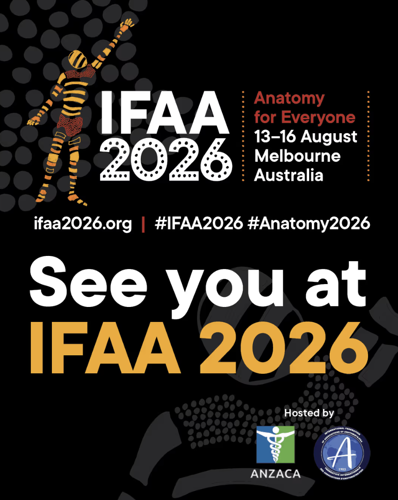
This is an opportunity to share our work, insights, and innovations with a global audience of colleagues and thought leaders in anatomy and related fields, including:
Anatomical Sciences Education
Surgical and Clinical Anatomy
Imaging Anatomy
Neuroscience and Cell Biology
Ethics and Law
Anatomy for Everyone, including Biological Anthropology, Forensics, Histology, Developmental Anatomy/Embryology
For more information regarding the registration, please visit this link: https://ifaa2026.org/en-AU/pages/registration/registration
Journal of Anatomy
For a summary of many of the published articles check out @JournalofAnat. As a member of the Anatomical Society you have access to these articles and to the Journal of Anatomy through Wiley Online Library.
Access the journal here.
The cover image for the latest issue is from a paper by A. Campbell et al., titled ‘Molecular insights into electroreceptor ribbon synapses from differential gene expression in sturgeon lateral line organs’.
The study aimed to identify genes involved in electroreceptor ribbon synapses in sturgeon and found that they are largely similar to hair cell synapses (glutamatergic and sharing key proteins) but show some distinct molecular differences
Access the paper here
The cover image for the journal's April issue is shown below:
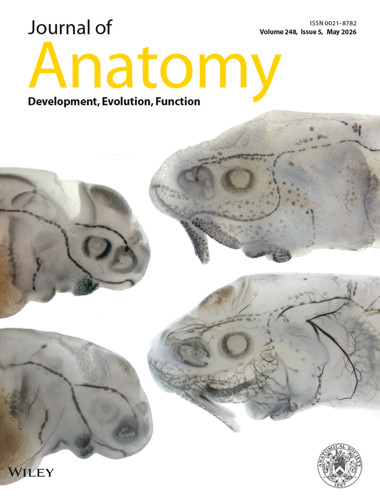
The cover image for the latest issue shows two larval stages of sterlet sturgeon (Acipenser ruthenus) immunostained for Sox2 (top) and for Sox2 plus acetylated alpha-tubulin (bottom). In the younger stage (left), Sox2 labels lines of neuromasts plus other sense organs (eyes, olfactory pits, taste buds). In the older stage (right), Sox2 also labels electrosensory ampullary organs flanking the neuromast lines. In both stages, acetylated alpha-tubulin labels nerve fibres.
Aging Cell
Aging Cell is a bi-monthly peer-reviewed, open access journal that aims to publish the highest quality, innovative research addressing fundamental issues in the biology of aging. We would like to remind you that our colleagues Aging Cell are now back on X and sharing exciting news and updates on articles from their journal. Please give them a follow @aging_cell
Access the journal here: Aging Cell
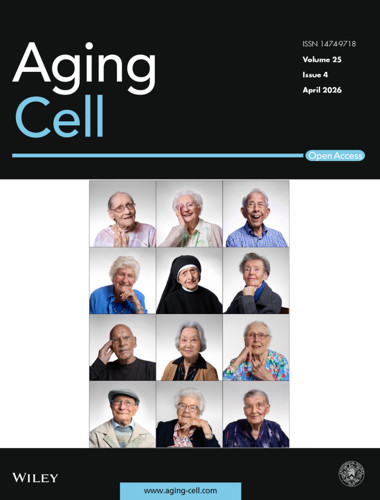
The cover image for the journal's April issue is shown below and is based on the article 'Plasma Proteome Profiling of Centenarian Across Switzerland Reveals Key Youth-Associated Proteins' by Flavien Delhaes et al.
The study aimed to identify plasma proteins associated with healthy aging in centenarians and found key “youth-like” proteins and pathways linked to longevity, particularly in metabolism, immunity, and cell survival.
Access the paper here
Vacancy
King's College London For more information about this post please click here | Job Title | Research Assistant |
Contract Type: | Full time post, fixed-term contract until 30/04/2029 | |
Organisation: | Business Unit: Dentistry, Oral & Craniofacial Sciences Department: Craniofacial & Regenerative Biology, King's College London | |
Remuneration: | £39,076-£43,909 per annum including London Weighting Allowance | |
Closing Date: | 17 May 2026 |