
Dr Sophie Miller Memorial Prize Lecture
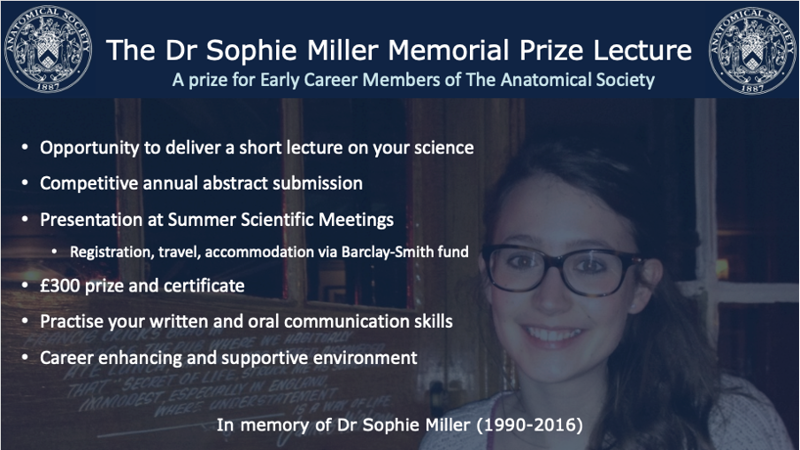
Background
The Dr. Sophie Miller Memorial Prize is an annual protected opportunity for early career members to present their own promising unpublished or early published anatomical research at the summer scientific meeting of the Society. The prize provides a career development platform dedicated to young researchers through supported attendance at the meeting, early experience in academic presentation (written abstract and extended oral presentation time), senior feedback, and publicity on the Society's website, social media outlets and newsletter.
Early career members are encouraged to submit an abstract (application form submission details below) for a short (20 minutes) lecture, to be presented by the winning applicant at the summer meeting in the same year. The abstract should detail the promise and early results of their research area, the relevance to the anatomy community and the future potential impact of the project. Applications should also describe how the prize will be of benefit to the applicant.
Dr Sophie Miller was an Anatomical Society funded PhD student from 2011-2014 at the University of Cambridge. She investigated olfactory ensheathing cells (OECs) and their potential for transplant-mediated repair of the central nervous system. During this time, she presented at many Anatomical Society meetings, with one of the publications from her PhD work appearing in the September 2016 issue of the Journal of Anatomy. Sophie was particularly supportive to her other early career researchers and colleagues in scientific and career development. She passed away in December 2016. In her memory, her family have generously provided support for young and aspiring anatomical researchers through the Anatomical Society.
Eligibility
Early Career Members must be society members within 5 years of graduation from a primary university undergraduate degree pertinent to anatomy, or current undergraduates.
Award
Annually, with £300 and a prize certificate. The prize winner will give their lecture at the summer scientific meeting of the society.
The award will be judged by the Prizes and Awards Committee and publicised on the Society's website, Anastomosis and social media outlets.
The prize winner may apply for the Barclay-Smith Travelling Fund for up to £400 towards the costs of meeting registration (and travel expenses and appropriate accommodation, if the meeting is in person). An application will be expected for Barclay-Smith Funding Round 3 in anticipation of the summer scientific meeting.
Application Entry Form Submission
Applications will open for the next round on 27th January 2026. Round now closed.
Applications require completion and return of the application form (Click here to download Sophie Miller Memorial Prize Application Form) a 1 page CV and a supporting paragraph from your supervisor or senior collaborator. All three parts of the application should be returned to the Society's Executive Administrator at maryanne.piggott@kcl.ac.uk.
Deadline for applications: 17th February 2026.
Queries
For further information please contact the Executive Administrator at: maryanne.piggott@kcl.ac.uk
Ms Lauren Barrett, University College Cork (UCC), Ireland.
'Uncovering the potential of SKOR1 as a novel therapeutic target for Parkinson’s Disease’.
Talk to be given at the Anatomical Society Summer Meeting, 15th to 17th July 2026, hosted by the University of Bristol.
Parkinson’s Disease is a common brain disorder that affects the coordination of movements. It is a progressive disease caused by an excess of a misfolded protein known as α-Synuclein causing the death of dopamine producing neurons, and there is currently no cure. SKOR1 is a protein that has previously been shown to be present at higher levels in experimental models of Parkinson’s Disease. We have found that reducing the levels of SKOR1 in laboratory models of Parkinson’s Disease protect against the damage caused by the α-Synuclein protein. We also know that aging is a major risk factor for Parkinson’s Disease, so we are using mice at various ages to examine the expression of SKOR1, α-Synuclein and related proteins in dopamine producing neurons across the lifespan as they age. Together, we hope that this work will bring us closer to discovering a new treatment for Parkinson’s Disease.
Ms Orla Mitchell, Royal College of Surgeons in Ireland (RCSI).
'Early Life Adversity & Brain Structure: A Longitudinal Structural MRI Study'
Talk to be given at the Anatomical Society Summer Meeting, 14th to 16th July 2025, hosted by the University of Oxford.
Exposure to early life adversity (ELA) is strongly linked to poor mental and physical health outcomes, yet the underlying mechanisms remain unclear. As part of the European IMAGEN project, this research examines how ELA influences brain development from adolescence to early adulthood using longitudinal MRI data collected at ages 14, 19, and 22. Findings indicate significant associations between ELA and structural brain changes, particularly in regions linked to emotional regulation. These alterations may contribute to an increased risk of psychopathology. The next phase of this work will explore whether these changes mediate this risk and whether resilience factors, such as caregiver attachment, offer protection. By deepening the understanding of how adversity shapes the developing brain, this research aims to identify potential intervention targets and improve outcomes for those affected by early adversity.
Mr Benjamin Davies, University of Cambridge.
'Exploring mammary terminal duct labular unit (TDLU) development using ovine and rabbit models.'
Talk to be given at the Anatomical Society Summer Meeting, 24th to 26th July 2024, hosted by the University of Edinburgh.
Terminal duct lobular units (TDLUs) are the functional units of the mammary gland, comprising a bilayer of luminal and basal myoepithelial cells. Utilising non-traditional models, we explored the role of myoepithelial cells in TDLUs during postnatal development. The mammary gland of the male sheep was also evaluated as a model for male mammary biology. Cell proliferation was assessed using immunohistochemical staining. This revealed distinct proliferation patterns of myoepithelial cells and highlighted species-specific proliferation dynamics. An AI-enabled image analysis pipeline was developed to isolate macrophages from optically cleared mammary tissue, aiming to elucidate the impact of contact with myoepithelial cells on macrophage morphology and phenotype. Examination of the male ovine gland revealed a diverse leukocyte population and demonstrated its utility as a model of male mammary gland biology. These results deepen our understanding of mammary myoepithelial cell biology.
Ms Ciara Walsh, University College Dublin, Ireland.
"An in vitro and ex vivo analysis of the potential of GeIMA hydrogels as a therapeutic platform for preclinical spinal cord injury"
Talk to be given at the Anatomical Society Summer Meeting, 25th to 27th July 2023, hosted by the University of Bangor.
Spinal cord injury (SCI) is a devastating condition for which no cure is available. Neuroinflammation is a major event post-injury, and immunomodulation can be applied as a therapeutic strategy to drive alternative immune cell activation and improve functional recovery. Hydrogels can achieve controlled and localised delivery of immunomodulatory biomolecules post-injury. However, to act as a successful immunotherapeutic platform, the hydrogel itself should not exacerbate the existing inflammatory response. Here, we analyze the immunogenicity of gelatin methacrylate (GelMA) hydrogels, to investigate their potential as a therapeutic platform for preclinical SCI. We show that 3% GelMA-A does not cause an inflammatory response in microglia or macrophages in vitro, and that 3% GelMA-A can support primary murine organotypic spinal cord slice culture ex vivo, with no direct effect on astrocyte/microglia reactivity. This shows that 3% GelMA-A is an immunologically inert hydrogel from which an immunotherapeutic system can be developed for preclinical SCI treatment.
Mr Cian O'Connor, Royal College of Surgeons in Ireland (RCSI)
"Development of biomimetic stem cell scaffold for spinal cord repair"
Talk to be given at the Anatomical Society Summer Meeting, 4th to 6th July 2022, hosted by the University of Dublin
Similar to the insightful work of Dr Sophie Miller, my Anatomical Society studentship research focuses on assessing the therapeutic potential of glial progenitor cells for transplant mediated nervous system repair. Following spinal cord injury, a lesion cavity forms preventing axonal regrowth. Despite ongoing development of stem cell treatments, repair remains a challenge due to the lack of a supportive environment. Tissue scaffold implants that physically bridge the cavity with a neurotrophic environment while delivering stem cells to restore lost tissue may have potential. Through optimizing scaffold stiffness and matrix composition, we developed biomimetic scaffolds inspired by the spinal cord anatomy. We show that biomimetic scaffolds enhance neurite outgrowth, promote immunomodulatory effects and enhance the trophic capacity of patient-derived stem cells with implications for spinal cord applications. Overall, and as Dr Miller previously published upon, this research contributes to enhancing scaffold borne stem cell treatments for nervous system applications.
Miss Christina Loukopoulou, University of Edinburgh
"Amalgamating anatomy with tissue engineering to produce an anatomically and clinically relevant in vitro bone-tendon construct for flexor tendon repair"
Congratulations to Christina Loukopoulou, PhD student at The University of Edinburgh, as the winner of the 2021 Dr Sophie Miller Memorial Prize for early career members.
We look forward to listening to Christina's talk which will be presented at the virtual summer meeting in Glasgow 7-9th July 2021
entitled:
'Amalgamating anatomy with tissue engineering to produce an anatomically and clinically relevant in vitro bone-tendon construct for flexor tendon repair'.

Dr. Kevin Byrnes, University of Limerick
"The mesentery: a new model of abdominal compartmentalisation?
The Anatomical Society is delighted to announce the first recipient of the Dr Sophie Miller Memorial Prize: Dr Kevin Byrnes, a PhD Student based in the Graduate Entry Medical School, University of Limerick.
Dr Byrnes will present his lecture “The mesentery: a new model of abdominal compartmentalisation?”, which we hope will be delivered at the Winter Meeting of the Anatomical Society in Newcastle, January 6th-8th 2021.
Regius Professor Simon Parson, President of the Anatomical Society highlighted the exceptional quality of the applications to this new prize, and the challenge in choosing a winner. We are delighted to be able to support Dr Sophie Miller’s parents who are kindly funding the Prize, in memory of their daughter.
Dr Sophie Miller’s parents commented "As Sophie's parents we are very proud of her research work and the passion and enthusiasm that she had for science. She would like nothing better than to encourage fellow scientists and we are delighted to celebrate her memory in this way and very grateful to the Anatomical Society for arranging it."
Dr Sophie Miller was an Anatomical Society funded PhD student from 2011-2014 at Cambridge University. She investigated olfactory ensheathing cells (OECs) and their potential for transplant-mediated repair of the central nervous system. During this time she presented at many Anatomical Society meetings, with one of the publications from her PhD work appearing in the September 2016 issue of The Journal of Anatomy.
She passed away in December 2016 and her family have generously provided support for young and aspiring scientists through the Anatomical Society in her memory.